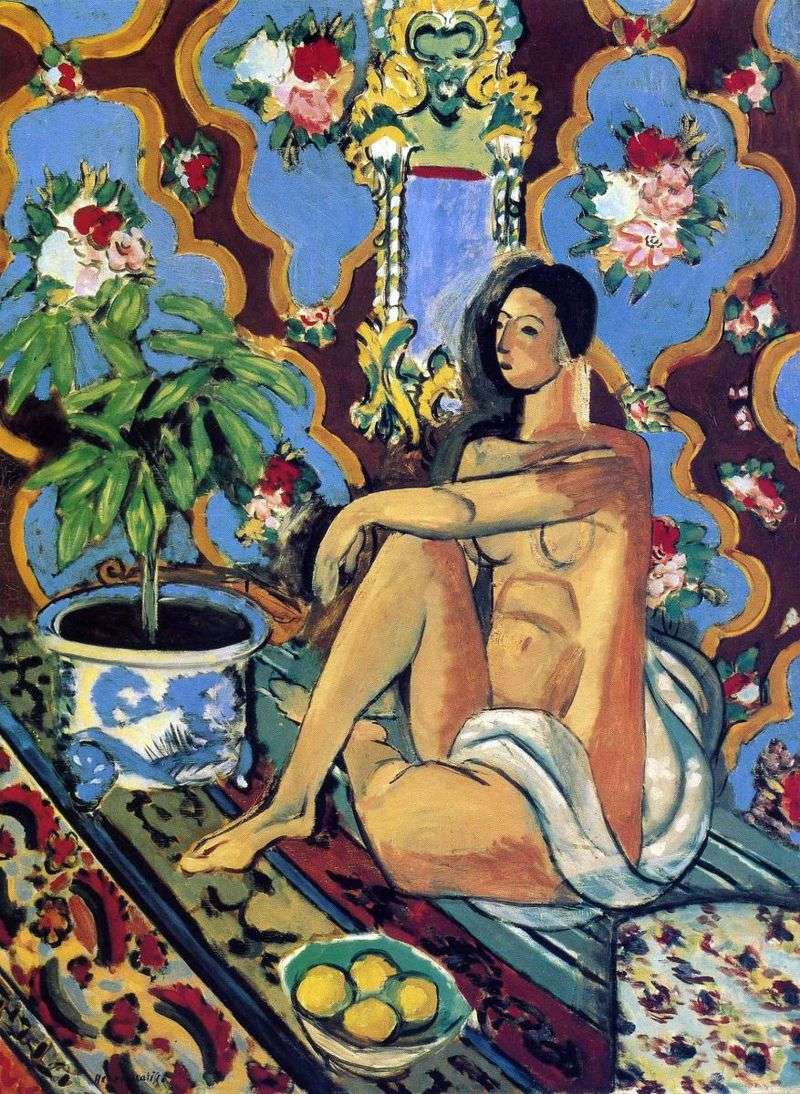
The odalisque sits staring off into the now. Completely comfortable in her body, belly, thighs, and all. She has come to terms with it and embraced her physical self.
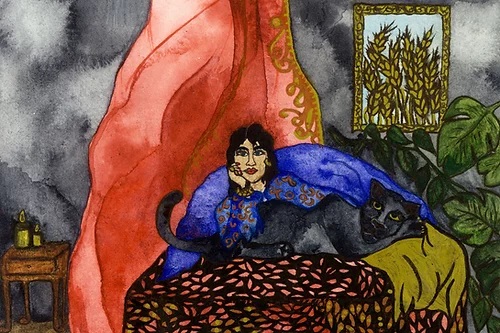
The artist is in love with color and is not concerned with flattering her, though she is gorgeous. She is just what I need as a muse – a woman at ease in her skin, able to tell her story, and willing to do so to anyone who will listen or to remain silent – according to the whims of her audience.
People talk of their muse as if a magical creature that drops art in their laps fully formed and ready to go. No. The muse is the inspiration for the art – the one who whispers in your ear….the stray thought that ties the piece together.
Matisse’s model for the Odalisque series was Henriette Darricarrère. She too was a painter. She gives the appearance of complete comfort and rest while holding her poses – for ten hours at a time. Art is not necessarily easy.
The blue and white porcelain pot with the plant echoes the blue and white porcelain in the room I am in as I write this.
NOTE: A million years ago when I was young, attractive and a middle-aged student at Marshall University, I wrote a paper that captured my imagination and secured my love of Cultural Anthropology. I had enormous fun writing this paper. Beware: it’s long — something like 33 pages long. I am posting it to archive it. You’re free to read it, of course, those who do report not only being interested, but amused.
NOTE #2: I sometimes refer to myself as once the world’s foremost authority on Minoan blue monkey frescoes. I would hope someone has cleared up the question as to why an ancient people in what is now Greece were drawing blue monkeys on their walls.
Sacre` Bleu!: Minoan Blue Monkey Frescoes
What ultimately gives a culture its character is its thought,
andthat–inaprehistoriccontext– is the most elusive characteristic of all….
Nevertheless, the Minoans left thousands of clues to guide us.
[Castleden, 1993, p. 123]
Introduction
This paper began as an attempt to sate my curiosity as to why a prehistoric people on an island in the Mediterranean felt compelled to paint monkeys – an animal not native to the area – and, moreover, why they chose to do so with blue paint. The paper ends with the development of my own, apparently unique, theory.
These prehistoric people, the Minoans, are generally believed to have developed a sophisticated culture on the island of Crete. Minoan or Minoan-influenced settlements, some argued to be colonies, are also found on the islands of Thera, Kythera, Rhodes, Naxos, Karpathos, Kea, and Melos, and on the Anatolian coast [Castleden, 1993, p. 117]. The differences between Neolithic assemblages and Early Minoan ones are sufficientlydissimilar as to suggest the Minoans were immigrants to the island, although Watrous discusses internal factors that may account for the cultural breaks [Watrous, 1994, pp. 703-704]. The material evidence of the Greek mainland during the Bronze Age suggests the Cretan Minoans were not the ancestors of the people who became the Classical Greeks [MacKendrick, 1981, p. 61]. Sometime after the volcanic eruption on Thera, the Minoan civilization began to dissipate, eventually to be replaced by the Mycenaean culture of the Grecian mainland. Their origin and demise is mysterious, but they left enough artifacts on Thera alone that “[e]ven if [Doumas] had the money- which he does not – to pay more restorers, the sheer weight of the archaeological evidence would occupy hundreds of people for decades.” [Ellis, 1998, p. 187.]
In “sound-bite” descriptions of Minoans, the bull leaping, polychromatic art/architecture, and undeciphered Linear A script are almost invariably mentioned as is speculation about status of the women. Yet, one does not have to delve very far into the literature to find mention of the blue monkey frescoes on the walls of a “palace” and other structures. They are held as examples of trade connections, serve as examples of the Minoans use of color, and have been used as evidence of Minoan colonization.
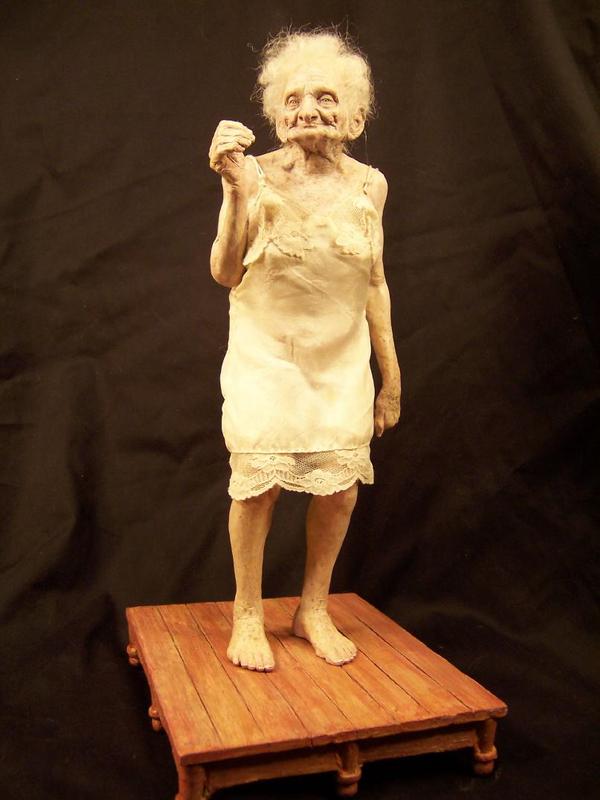
Some time before 2010 Angela Talbot created a piece of art – a sculpture. I can’t find Ms. Talbot and I don’t know the piece’s proper name, but in the few web instances where I can find the image she is called “Old Lady.’
I love this old woman.
I came across the photo on March 1, 2010 and nicked it to use to illustrate a blog post about how I hate to paint.
I was young, I was foolish. I know better now. I don’t steal images from the internet any longer. (I use Creative Commons and the like and use them legally.)
Along about 2019, someone nicked the photo from me and posted it to Pinterest making that post of mine my all-time most popular knocking off the pedestal the one about negligees.
You would not believe how many hits I get off of that photo. Daily. Every day. I get excited at the stats and go look, but nope, it’s just Angela’s artwork gathering viewers. It really is quite the piece.
I do wish folks would stay around and read a bit.
I lied. I’m going to steal one more photo. This from AngelaTalbotCreations on My Space. The Old Lady in all her glory. If you know how to contact Angela, please let me know.