Where did you find this card? It is scrumptious — hand-made paper and a soft watercolor image that I think might have been an original. You didn’t make this, did you? Was this all your handiwork?
If so, I’ve never had a handmade card deliver an I’m breaking up with you message before.
Your card arrived in the mail today. I noticed the pink envelope first, and then my heart beat faster when I saw it was your handwriting.
You’ve always been an original.
My heart stopped for a minute after I read the first line. Although those opening words were innocuous, I knew what was coming. I knew as soon as I saw your writing on the envelope.
There’s a pot of potato soup at a slow simmer on the stove. Everything about this day is slow. Unhurried. Leisurely. Unfolding gently from the dark of predawn to the sunset at 5:07 pm. It is a day to burrow into all the comforts that make home home. Pumpernickel bread is baking and the house is filled with the smell of caraway seed. Irish butter was procured for the bread and mulled cider will round out the evening menu though Louisa is considering making gingerbread for dessert. She nestles deeper into the chair as she considers the expenditure of energy that will take.
Gingerbread would be good. There is heavy cream to turn into whipped cream, but the kitchen is spotless, and she is not sure she wants to clean it again. Louisa ponders.
Royce is napping upstairs. She figures she has the house to herself for another hour. He is a marathon sleeper. No 20-minute power naps for him. He says anything less than two hours is not worth his time.
The house is silent except for the hum of the furnace and the purrs of the cat.
She has not had the television on at all this day and silenced her phone several hours ago.
Louisa is hibernating in the peace she and Royce have built in their 30 years of marriage. All the rough edges have smoothed. They fit together like the two halves of the yin-yang. Both are strong personalities, but they have long worked out their friction points without giving up their identities. They are not two shall become one, but two that curve together in all the right places.
It was a lot of work. These past six, seven years have been ones of ease and plenty. Love and friendship. Passion and camaraderie. He still makes her laugh. She still makes him think.
The forecast called for just flurries, but Louisa estimates there are two inches of flurries accumulated on the back deck. There is no place she needs to be. There is nothing she should be doing. All that concerns her is whether she wants to make gingerbread or not.
She decides that the smell of gingerbread baking will heighten further this intense feeling of contentment. The warmth of it will further keep at bay the bluster of the outside world.
Can contentment be intense? Is that an oxymoron?
She whispers a small prayer: May all beings know this feeling. But she doesn’t dwell on it. She does not want to consider the reality of the the all-too real world.
Dawn is the sacred hour. We move from one world to the next accompanied by a dramatic lighting of this world.
Old Window in Finland by Helena Turpeinen, poster to View From My Window Facebook group
It wasn’t until my late 40s I was able to appreciate or regularly meet the dawn. If my sleep schedule ever regulates, I will miss these holy hours. I wake in the dark and cast off the stories my psyche told me while asleep and head for my beloved roll-top desk.
Dependent on the time of year, it could be some time before the dawning or just minutes.
But as I write the stories and sip coffee in silence, I glance over my shoulder through the atrium doors to look for the first arc of light.
It usually begins as a soft peachy pink rising with the fog over the hills and peeking through the trees. Dependent on weather and time of year, the color will sometimes intensify, sometimes wane, but always is a hearkening.
Here we are again. We made it to another day.
The silence is important.
Soon, the birds will start and the world will begin its hustle, but for a few minutes it’s just light and the creation of a new day, the creation of a new story to be told. Color on the silhouettes of the mountains bring me such contentment.
In twelve days, I will be on the shore of Lake Okeechobee in Florida. I’ve never been there before but I’ve seen sunset photos–another sacred part of the day. I am eager to nestle with my lover before leaving our bed to sit on the dock with my mug of coffee and journal. It won’t be silent – the lapping of the tide should, will, create its own sounds of peace. I am eager to see the Spanish moss hanging from the trees light up as the sun begins it ritual.
I’m sure I will photograph the scene in order to remember it, but I hope it imprints on my heart.
This is the sacred hour. Rejoice in the silence and witness the light. Turn to a new page and tell the story.
Maisie Anne O’Keefe looked to be Black Irish – that sumptuous result of Spanish DNA and Irish DNA colliding, but in reality she was Scots.
Upon her birth, both parents looked at the other and said, “This wee one does not have red hair.” Both were present at the home birth, or they might have wondered if babies had been confused in the nursery. Maisie Anne was the 7th daughter of a 7th son and and the 7th daughter of a 7th daughter. Gossip had been rife throughout Adelaide’s pregnancy. This child is fae, the village folk whispered.
And indeed, Maisie Anne O’Keefe grew into the reputation the village folk had invoked with their words.
Art by Paula Belle Flores
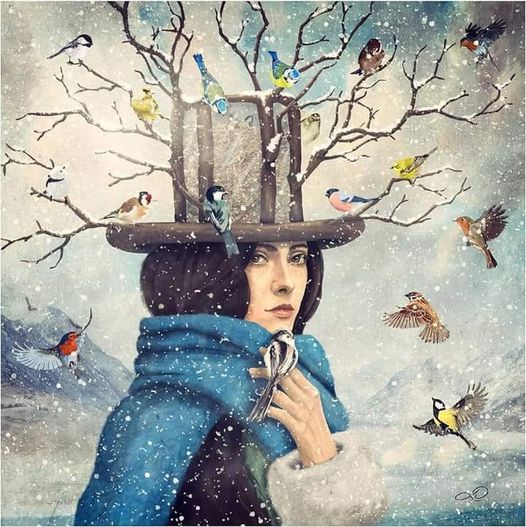
While still small, she exhibited an affinity for and a bond with birds. Any time she left the cottage, the birds would gather about her. As they grew bolder, they would perch on her shoulders, her hands, her arms, and even her black tresses. As time went by, they began gathering at her doorway each morning eager for her exit.
She kept seeds and whatnot in a pouch tied about her waist and she would feed the birds as she walked to the shoppe in the square where she served tea.
One winter began early and was fierce. The snows came and stayed and she didn’t have enough seed on hand to adequately feed all the birds that waited outside her door. She feared for the birds though she wasn’t usually prone to fear. The birds, the villagers whispered, were her familiars. Maisie Anne thought of them as her children as the years had gone by and would-be suitors were too intimidated to woo her. Her parents had died, and her siblings had scattered. She alone lived in the cottage and had meager means.
That evening she set to with the saw her father had used as well as his hammers and nails. She needed a warmer hat and the birds needed shelter from the cold. When she was almost done, she went outside, perched the ladder to the side of the cottage, climbed up, and grabbed some straw. The cottage had been fresh thatched that autumn and the straw was almost pristine.
When she was done, she had a hat of branches, straw, and wood for the birds to use for warmth. They flocked to her in numbers the villagers had never seen. When they asked Maisie Anne what she had done, she replied that she couldn’t keep them from starving, but she could keep them warm.
The following morning, Maisie Anne left the cottage sporting her hat and discovered that during the night the villagers had left bags and bags of seed for the birds and provisions for Maisie Anne.
She and her hat became a spectacle each and every winter from that time forward. Tourists came from miles around to see the fae0 one feed and shelter the birds. The tea shoppe did very well with the added custom and Maisie Anne’s wages were increased, but still the villagers provided for her and the birds.


 W. Va. Fur and Root