Reading Rage

I’m looking at an image by Canadian artist Denis Chiasson.  I see with an old woman’s eyes now.  The image is not as clear as I need it to be to discern if she is holding a pen.  I choose to think she is.  I also choose to believe she is reviewing a card she just inscribed for someone.  Perhaps to accompany a gift. 
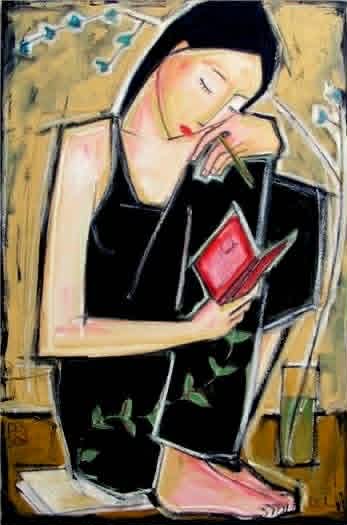
She looks a lot like me in my youth.  Thin.  Angular.  Limber.  But she is too still.  At that age, I was a blur, always moving, always doing.  I inscribed many cards with heartfelt sentiments, but often while standing in line at the post office or while talking on the phone at work. 

Perhaps the woman in the image is just reading.  

I did read a lot.  Incessantly.  If I wasn’t working or dancing or getting ready for those two activities, I was reading – lost in other worlds. 

I delighted in well-researched historical novels with the occasional foray into romance.  Kathleen Woodiwiss was a favorite of mine in that genre.  It wasn’t until later that I realized she was poisoning my mind.  Love does not start with rape.

What strange times I’ve lived through.

I preferred, at first, to read on the sofa, sometimes reclining and sometimes sitting, moving to the bed about an hour before I needed to shut off the light.  Eventually, I read in bed whenever I could. 

I am reviving my reading habit.  The events of the last 12 years took it from me, not the least of which is the age of my eyes and the arthritis in my hands.  Holding a book can be uncomfortable, particularly while supine.  I have brushed the dust off the Kindle, and it’s a godsend.  It weighs nothing, and I can enlarge the print.  It’s been a fabulous return to the magic of squid juice on wood pulp – a phrase Frank X. Walter uses to describe writing.  But in this case it’s pixels on glass.  Or something like that. I no longer even try to keep up with the terms of new tech.

I used to carry books with me everywhere.  Since I held the opinion that the thicker a book was the better it was – a publisher would not put the money into such if it weren’t an exceptional story – the tomes I lugged around were huge.  Some were nearly a 1000 pages.  Coupled with a typing speed of more than a hundred words a minute and a lifetime of earning my living at a typewriter or keyboard, it’s no wonder my hands ache. 

The Kindle will be so much easier.  It will slip into most of my purses and weighs nothing – a boon to cramping arthritic hands. 

Technology continues to be good to me. 

Can you imagine the wonder of the printing press?  Gutenberg changed the world.  A revolution, but like all new technology, it wasn’t without controversy.

I despise Artificial Intelligence (see? – new tech controversy), but Google’s AI finds a half-remembered meme. 

Terms like “reading rage” or “Pamela-fever” described the concern that grew as books became easier and easier to own and literacy spread like a virus. 

Crescendoing in the 1800s, “Reading Rage” sparked debates over the new media’s impact. Google AI also tells me that Pamela-fever refers to Samuel Richardson’s novel Pamela and that Goethe’s Werther, along with Pamela, challenged social conventions and encouraged independent thought, provoking a backlash.  I understand parents particularly feared for their teenage kids. 

In these years of constant new media and new tech, parents still worry for their children. Some things do, in fact, not change.

I’ve read Pamela, though I don’t remember it, but I have no Goethe in my brain other than a quote here and there.  I’ll rectify that. He’s considered a classic, and there are many classics on Kindle for free or pert near.  Anything that inspires independent thought and challenges social norms is right up my alley.

It looks to be another gloomy day.  I will delight in crawling underneath sheets and blankets with my beloved dachshund Emmylou nestled against my back – reading.  And then no doubt napping. 

An enjoyable day ahead of me.  I think. 

I hope so for you as well.  Happy Boxing Day.
Fractured Ekphrastic: The Conversation

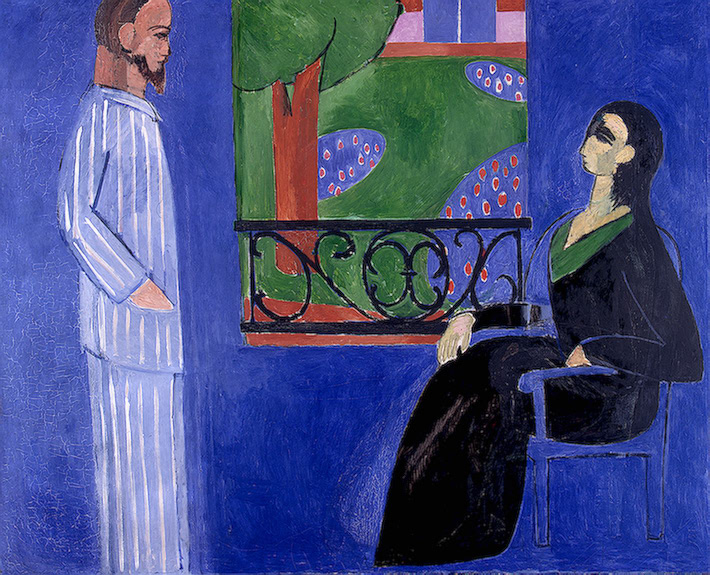
Alice R. Henderson is believed to have painted the piece attributed to Matisse titled The Conversation.  The image is that of a dark-haired woman in a black robe sitting in a chair.  Standing opposite her is a red-headed man.  He is wearing pajamas.  The expressions on their faces are familiar but hard to put to words, although it is clear the woman is not happy.

Persephone wants to leave early, and Hades won’t let her. For six months of every year, for centuries now, she has gone to the underworld and hidden herself away.  The earth transitions to winter during her confinement, and the people long for a return to warmth and growth. But Persephone is forced to stay in her chambers and slumber. She is weary of sleep.  Weary of stillness.  Weary of the silence.  

The look Alice R. Henderson painted on their faces is one of yearning and discontent.  The people who line up to view this painting, all of them, instantly vibrate.  They know that look.  They know the feeling is uncomfortable, but they don’t have the words.  They can’t have The Conversation.

They want to.  Oh, how they want to.   Everyone views the painting and regards it as a Zen koan.  They don’t know what that look is, but when they leave, they are transformed.  They make changes.  They leave jobs, they leave marriages, they leave countries.  When asked to explain, they say nothing, or they say, “I don’t have the words” or they say “Go see the painting.” 

They know the feeling is uncomfortable, but they don’t have the words. They know the feeling provokes change.  They have had the conversation and expressed their discontent and expressed what it is they yearned to experience. The conversation between their heart and their brain was silent, but the silence reverberated. It is revealed in the lives they go on to live.

Persephone wants to wake.  She wants to return to warmth and growth.

Note: Alice R. Henderson was Matisse’s scullery maid. 
He noticed her artistic promise when he saw her drawing rather than eating during her meal break.
It has been alleged that Matisse’s departure from the open, spontaneous brushwork of his Fauve period in favor of a flatter, more decorative style coincides with Henderson’s employment at the Matisse residence.
No one is sure how much of what is attributed to Matisse is actually Henderson’s work.

*****

[An aside: As are many of my stories, essays, and poems, this one began as my response to a writing prompt.

For this one, we were given an image of an older woman holding a candle (I think-we were only given a moment or so to view the painting.]

The image was accompanied by this text: What story did she recreate as art?

There is no Alice R. Henderson. Matisse did indeed paint The Conversation, and it is a self-portrait of the artist and his wife. Matisse is an interesting guy, but so too was his wife. It has been postulated that many of Matisse’s shenanigans were orchestrated to draw attention away from his wife while she was working with the French Underground during the Nazi occupation of France.

This enigmatic piece has haunted me for years.]

Blue Asters

The stained glass tries to compete but fails to overtake the scene.  The vase too is spectacular as is the old rough hewn window ledge. The vista outside the window takes nearly  5 minutes before it is noticed though the mountains are lovely. 

But those flowers.  That blue atop green stems.  The color of the Aegean.  The color of an infant’s newborn eyes. The color of my love for you.

Shakespeare would have composed a sonnet.  Byron an ode.  I am too close to my dreams.

 I have but these few words that have escaped the remnants of sleep.

Maisie Anne The Fae

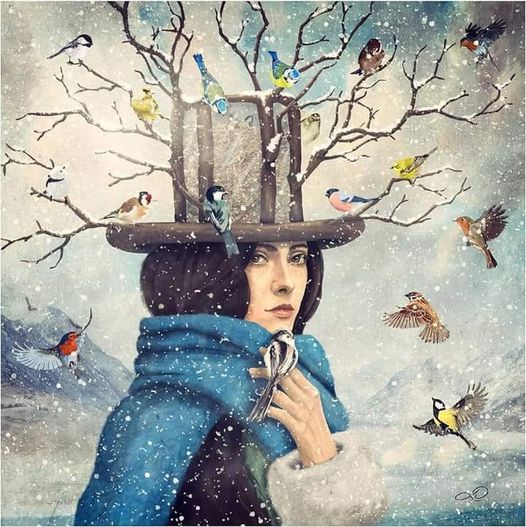
Maisie Anne O’Keefe looked to be Black Irish – that sumptuous result of Spanish DNA and Irish DNA colliding, but in reality she was Scots. 

Upon her birth, both parents looked at the other and said, “This wee one does not have red hair.”  Both were present at the home birth, or they might have wondered if babies had been confused in the nursery. Maisie Anne was the 7th daughter of a 7th son and and the 7th daughter of a 7th daughter.  Gossip had been rife throughout Adelaide’s pregnancy.  This child is fae, the village folk whispered.

And indeed, Maisie Anne O’Keefe grew into the reputation the village folk had invoked with their words.

Art by Paula Belle Flores

While still small, she exhibited an affinity for and a bond with birds.  Any time she left the cottage, the birds would gather about her.  As they grew bolder, they would perch on her shoulders, her hands, her arms, and even her black tresses.  As time went by, they began gathering at her doorway each morning eager for her exit. 

She kept seeds and whatnot in a pouch tied about her waist and she would feed the birds as she walked to the shoppe in the square where she served tea.

One winter began early and was fierce.  The snows came and stayed and she didn’t have enough seed on hand to adequately feed all the birds that waited outside her door.  She feared for the birds though she wasn’t usually prone to fear.  The birds, the villagers whispered, were her familiars.  Maisie Anne thought of them as her children as the years had gone by and would-be suitors were too intimidated to woo her.  Her parents had died, and her siblings had scattered.  She alone lived in the cottage and had meager means.

That evening she set to with the saw her father had used as well as his hammers and nails.  She needed a warmer hat and the birds needed shelter from the cold.  When she was almost done, she went outside, perched the ladder to the side of the cottage, climbed up, and grabbed some straw.  The cottage had been fresh thatched that autumn and the straw was almost pristine.

When she was done, she had a hat of branches, straw, and wood for the birds to use for warmth.  They flocked to her in numbers the villagers had never seen.  When they asked Maisie Anne what she had done, she replied that she couldn’t keep them from starving, but she could keep them warm.

The following morning, Maisie Anne left the cottage sporting her hat and discovered that during the night the villagers had left bags and bags of seed for the birds and provisions for Maisie Anne.

She and her hat became a spectacle each and every winter from that time forward.  Tourists came from miles around to see the fae0 one feed and shelter the birds.  The tea shoppe did very well with the added custom and Maisie Anne’s wages were increased, but still the villagers provided for her and the birds.