I want a word that means to feel it all at once. To include the cognitive dissonance with the revelation of divine knowledge. To embrace the sacred and the profane. I want that word to recognize that I can be at peace and at war within myself at any moment, either one or both simultaneously.
To feel it all at once is to glimpse the mind of the creator. Perhaps. I want the ennui and the exhilaration of my being to dance. A tango. Slow, deliberate, sinuous, winding about one another until the boredom embraces the joy reaching crescendo. And then there is silent acceptance of both when the music fades.
This is my life now. I don’t want to call it a new normal. I despise normal – always have. I have striven all my life not to be average. I’d rather be a failure than just fade to black.
This life, the one right here, the one that I call a trainwreck, is mine and I don’t want to shut down any part of it. It has become who I am.
I was in a trainwreck one time. Really. I hit a train. It makes for a great party story.
And that is my goal: to ferment all of this into a story that both bears witness to the tragedy and provokes laughter at having trried to overcome it all and only sometimes succeeding. I want to coin that word.
If we can’t laugh, we can’t cry, and both are necessary for either to have any potency. Any meaning. Any effect.
I want a word for all of this. These events and feelings and effects have shaped me and continue to shape me into a person I hardly recognize, but who is resolutely and most definitely me.
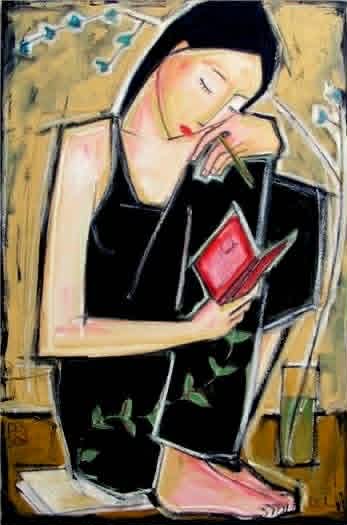
I’m looking at an image by Canadian artist Denis Chiasson. I see with an old woman’s eyes now. The image is not as clear as I need it to be to discern if she is holding a pen. I choose to think she is. I also choose to believe she is reviewing a card she just inscribed for someone. Perhaps to accompany a gift.
She looks a lot like me in my youth. Thin. Angular. Limber. But she is too still. At that age, I was a blur, always moving, always doing. I inscribed many cards with heartfelt sentiments, but often while standing in line at the post office or while talking on the phone at work.
Perhaps the woman in the image is just reading.
I did read a lot. Incessantly. If I wasn’t working or dancing or getting ready for those two activities, I was reading – lost in other worlds.
I delighted in well-researched historical novels with the occasional foray into romance. Kathleen Woodiwiss was a favorite of mine in that genre. It wasn’t until later that I realized she was poisoning my mind. Love does not start with rape.
What strange times I’ve lived through.
I preferred, at first, to read on the sofa, sometimes reclining and sometimes sitting, moving to the bed about an hour before I needed to shut off the light. Eventually, I read in bed whenever I could.
I am reviving my reading habit. The events of the last 12 years took it from me, not the least of which is the age of my eyes and the arthritis in my hands. Holding a book can be uncomfortable, particularly while supine. I have brushed the dust off the Kindle, and it’s a godsend. It weighs nothing, and I can enlarge the print. It’s been a fabulous return to the magic of squid juice on wood pulp – a phrase Frank X. Walter uses to describe writing. But in this case it’s pixels on glass. Or something like that. I no longer even try to keep up with the terms of new tech.
I used to carry books with me everywhere. Since I held the opinion that the thicker a book was the better it was – a publisher would not put the money into such if it weren’t an exceptional story – the tomes I lugged around were huge. Some were nearly a 1000 pages. Coupled with a typing speed of more than a hundred words a minute and a lifetime of earning my living at a typewriter or keyboard, it’s no wonder my hands ache.
The Kindle will be so much easier. It will slip into most of my purses and weighs nothing – a boon to cramping arthritic hands.
Technology continues to be good to me.
Can you imagine the wonder of the printing press? Gutenberg changed the world. A revolution, but like all new technology, it wasn’t without controversy.
I despise Artificial Intelligence (see? – new tech controversy), but Google’s AI finds a half-remembered meme.
Terms like “reading rage” or “Pamela-fever” described the concern that grew as books became easier and easier to own and literacy spread like a virus.
Crescendoing in the 1800s, “Reading Rage” sparked debates over the new media’s impact. Google AI also tells me that Pamela-fever refers to Samuel Richardson’s novel Pamela and that Goethe’s Werther, along with Pamela, challenged social conventions and encouraged independent thought, provoking a backlash. I understand parents particularly feared for their teenage kids.
In these years of constant new media and new tech, parents still worry for their children. Some things do, in fact, not change.
I’ve read Pamela, though I don’t remember it, but I have no Goethe in my brain other than a quote here and there. I’ll rectify that. He’s considered a classic, and there are many classics on Kindle for free or pert near. Anything that inspires independent thought and challenges social norms is right up my alley.
It looks to be another gloomy day. I will delight in crawling underneath sheets and blankets with my beloved dachshund Emmylou nestled against my back – reading. And then no doubt napping.
Marina continued although a little distracted. The show must go on reverberated in her head. She forced herself to pay attention to the person sitting across from her.. She had to work very hard to stay in the present as her heart was visiting the past and her soul was questioning the future. When she was done, even more spent than usual, she went to her hotel room. Normally after a performance, she would shower and anoint herself in almond oil. Massaging each foot, each limb, each hand. She would end by caressing her face and then wiping her hands on her long wet hair. Her people had oiled their hair for centuries.
But after this one, after she sluiced off the intimacy of strangers, she sat on the edge of the bed and stared at herself in the mirror – trying to read her own eyes, trying to make sense of 30 years collapsing in one minute.
Did she want to try and find him. Would he contact her? She stared at herself.
Did she want to see him?
Once again, he paralyzed her. When with him, she was a slave to the oxytocin and dopamine coursing through her body, addicted to his touch on her skin, helpless in his examination of her eyes. She had been in danger of losing herself –of being consumed by a passion so intense it would incinerate her will.
The phone on the nightstand rang. It took her a moment to place the sound. She answered with a soft “Hello.”
“Ms. Abramovic, there is a gentleman here to see you.”
“Is he wearing a shirt with a red collar? With kind eyes?”
“Well, I don’t know about that last part, but yes. That is what he is wearing.”
Please tell him I can meet him in the bar in about 20 minutes.
Marina continued to sit staring at her whole self in the mirror. Sitting here naked she did not feel as exposed as she did when looking into strangers’ eyes. Far more exposed when she looked into his eyes.
She stood and pulled on her old, very faded and threadbare Levis. She wore these back when they were together. The denim was an old friend grounding her to her past but allowing her to venture into her future.
She rummaged around in her suitcase looking for something besides a t-shirt but she wasn’t coming up with anything she felt appropriate to the occasion or the place. Finally, she decided on a white silk camisole over which she threw on the cardigan she’d bought in Nepal shortly after they had parted.
With no makeup, no perfume, wet hair and barefoot, she quietly closed her hotel room and padded down the corridor to the elevator.
She didn’t know what she would say.
She didn’t know what she wanted to say.
Thirty years had fallen away in a minute.
What would time do this evening?
*****
NOTE: I was shown this video as a writing prompt and told to write what happened next.
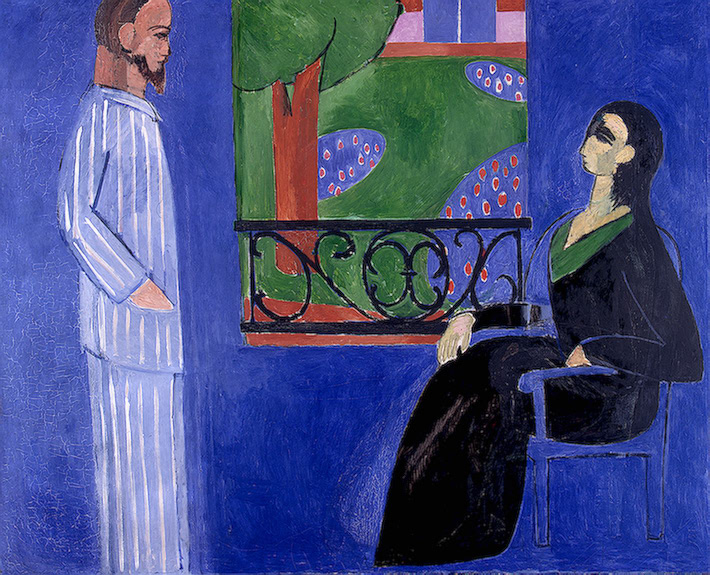
Alice R. Henderson is believed to have painted the piece attributed to Matisse titled The Conversation. The image is that of a dark-haired woman in a black robe sitting in a chair. Standing opposite her is a red-headed man. He is wearing pajamas. The expressions on their faces are familiar but hard to put to words, although it is clear the woman is not happy.
Persephone wants to leave early, and Hades won’t let her. For six months of every year, for centuries now, she has gone to the underworld and hidden herself away. The earth transitions to winter during her confinement, and the people long for a return to warmth and growth. But Persephone is forced to stay in her chambers and slumber. She is weary of sleep. Weary of stillness. Weary of the silence.
The look Alice R. Henderson painted on their faces is one of yearning and discontent. The people who line up to view this painting, all of them, instantly vibrate. They know that look. They know the feeling is uncomfortable, but they don’t have the words. They can’t have The Conversation.
They want to. Oh, how they want to. Everyone views the painting and regards it as a Zen koan. They don’t know what that look is, but when they leave, they are transformed. They make changes. They leave jobs, they leave marriages, they leave countries. When asked to explain, they say nothing, or they say, “I don’t have the words” or they say “Go see the painting.”
They know the feeling is uncomfortable, but they don’t have the words. They know the feeling provokes change. They have had the conversation and expressed their discontent and expressed what it is they yearned to experience. The conversation between their heart and their brain was silent, but the silence reverberated. It is revealed in the lives they go on to live.
Persephone wants to wake. She wants to return to warmth and growth.
Note: Alice R. Henderson was Matisse’s scullery maid. He noticed her artistic promise when he saw her drawing rather than eating during her meal break. It has been alleged that Matisse’s departure from the open, spontaneous brushwork of his Fauve period in favor of a flatter, more decorative style coincides with Henderson’s employment at the Matisse residence. No one is sure how much of what is attributed to Matisse is actually Henderson’s work.
*****
[An aside: As are many of my stories, essays, and poems, this one began as my response to a writing prompt.
For this one, we were given an image of an older woman holding a candle (I think-we were only given a moment or so to view the painting.]
The image was accompanied by this text: What story did she recreate as art?
There is no Alice R. Henderson. Matisse did indeed paint The Conversation, and it is a self-portrait of the artist and his wife. Matisse is an interesting guy, but so too was his wife. It has been postulated that many of Matisse’s shenanigans were orchestrated to draw attention away from his wife while she was working with the French Underground during the Nazi occupation of France.