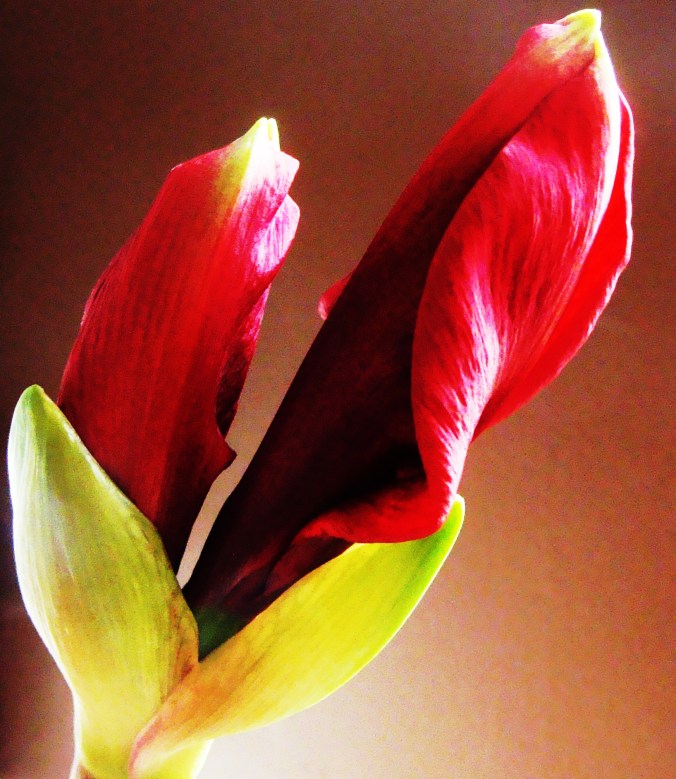
- Bulging buds out of nowhere.
Sometimes I find myself standing in cut-rate shopping emporium specializing in factory overruns and slightly damaged goods waiting for the cashier to bag my purchases. Since I have a fetish of sorts for dishes, my purchase is likely to involve sushi plates I don’t need or ramekins I do, or some sort of fragile item. After a few minutes watching the cashier swaddle the finger bowls, I say something like “Just toss it in the bag. If it can’t survive the trip home, it can’t survive my house.”
This is one of the Barn’s great truths You have to be tough to live here. The second great truth is You have to thrive on neglect.
With few exceptions, if it’s in my house, it’s here to be enjoyed. That was one of the tenets of the Great De-Junking of 2005-2008 (and counting): No more “saving for something special” – wrapped in bubble wrap, nestled in a box and stored in a reinforced container pending the arrival of “Something Special”.
I’m not careless (for the most part). Still, I have things that are chipped or just downright broken that other people would toss. As long as they are still usable and/or make me smile, they’re still here. Some people are appalled by this. Some people see it as an opportunity to replace whatever it is at the next gift-giving occasion. Some people understand it for what it is.
The goal is, and has been, to have only things that I love.
I veer towards the strange in the things (and people) I choose to love.
I love this house. A sensible person would bulldoze it.
I love my dogs. Rational people would send them to foster care for rehabilitation.
I love dishes. There’s no excuse for this. I just do.
I love most of my stuff. (I’m working on that most.) People are either charmed or horrified when they walk in here.
I love houseplants, but I’ve noticed over the years that I go in a yearly cycle. I lovingly tend them from early spring to mid-summer at which time they are summarily ignored to tend to the garden. For the remaining 8-9 months, they’re lucky if they get watered. After years of this, I have plants that can thrive on willpower alone.
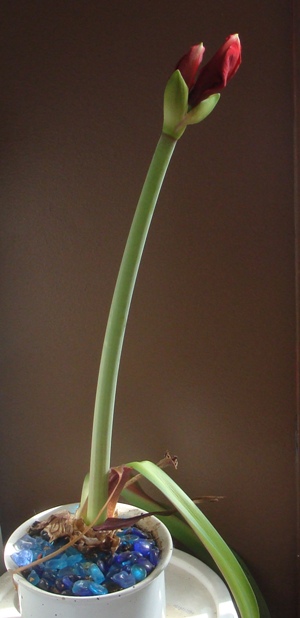
19 inches of spectacular surprise.
One of the plants is an amaryllis that I acquired from somewhere or someone so many years ago now that I can’t summon the details. I vaguely remember putting the bulb in the pot that came with it, tossing potting soil on top of it, and watching leaves sprout. It took several years before it did anything but produce leaves. I read up on amaryllis bulbs. I was supposed to do this and this and a fair amount of that, put it in a closet for X amount of weeks, recite incantations, and feed it baby giggles ground with rainbow sludge. But I never did any of that. It sat on my counter and did or did not grow more leaves. For 11 months of the year, it is droopy, long leaves collecting dust and spider webs on the plant counter. Periodically one of the leaves will turn brown and crispy and I will allow as how that leaf is truly dead, rip it off and throw it away. It always looks half-dead or dying. Other than pulling off the certainly-dead parts and the occasional splatter of water, it fends for itself.
One year, well after Christmas and without any sounding trumpets, it bloomed. Initially, I thought the end-times were upon us. Sometimes in February and sometimes in March, and this year in April, it will suddenly sprout a stalk that Jack would recognize. I do mean suddenly. In less than 24 hours, there was no stalk and then there was a stalk 19″ tall (I measured). At the top of the stalk, a bulbous, faintly obscene bulging will emerge. The bulge gets bigger. And bigger. Soon you can see hints of red in the green.
Alien probes come to mind.
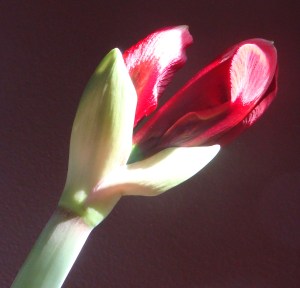
A lesson to learn.
The first year it did this, we all scooted kitchen chairs up to the counter and watched in fascination.
But this year two bulbous bulgings appeared. We’re now into Hour 36 (or so) of the alien probe. I’ve witnessed this transformation for several years now, so I’m not as mesmerized as I once was. But it’s still pretty amazing. I’ve yet to become blasé about it. When I do, I’ll give it to someone.
The amaryllis, without any help from me, is blooming. It hasn’t been repotted in ten years. It hasn’t been fertilized. Life can’t be much harder for this plant. You’ve got to thrive on neglect around here if you’re an indoor plant. You’ve got to be tough.
The fool thing is not only blooming. It’s double blooming.
There’s got to be a lesson in here that will do my beleaguered heart some good.