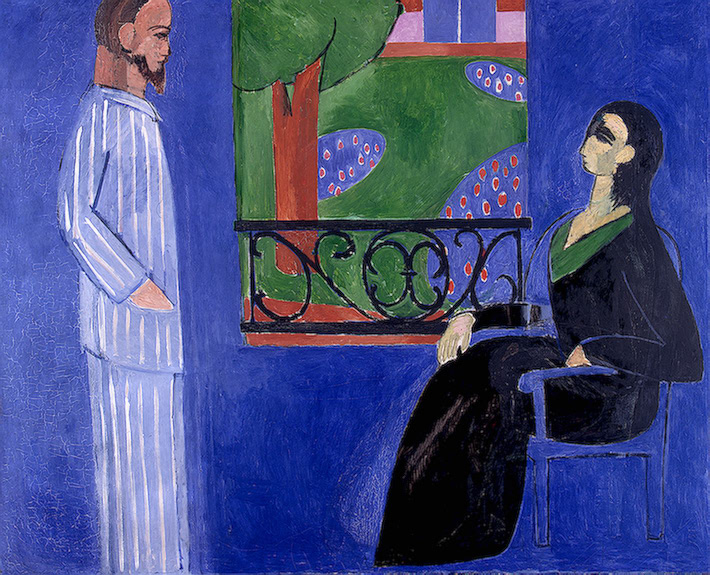
Alice R. Henderson is believed to have painted the piece attributed to Matisse titled The Conversation. The image is that of a dark-haired woman in a black robe sitting in a chair. Standing opposite her is a red-headed man. He is wearing pajamas. The expressions on their faces are familiar but hard to put to words, although it is clear the woman is not happy.
Persephone wants to leave early, and Hades won’t let her. For six months of every year, for centuries now, she has gone to the underworld and hidden herself away. The earth transitions to winter during her confinement, and the people long for a return to warmth and growth. But Persephone is forced to stay in her chambers and slumber. She is weary of sleep. Weary of stillness. Weary of the silence.
The look Alice R. Henderson painted on their faces is one of yearning and discontent. The people who line up to view this painting, all of them, instantly vibrate. They know that look. They know the feeling is uncomfortable, but they don’t have the words. They can’t have The Conversation.
They want to. Oh, how they want to. Everyone views the painting and regards it as a Zen koan. They don’t know what that look is, but when they leave, they are transformed. They make changes. They leave jobs, they leave marriages, they leave countries. When asked to explain, they say nothing, or they say, “I don’t have the words” or they say “Go see the painting.”
They know the feeling is uncomfortable, but they don’t have the words. They know the feeling provokes change. They have had the conversation and expressed their discontent and expressed what it is they yearned to experience. The conversation between their heart and their brain was silent, but the silence reverberated. It is revealed in the lives they go on to live.
Persephone wants to wake. She wants to return to warmth and growth.
Note: Alice R. Henderson was Matisse’s scullery maid.
He noticed her artistic promise when he saw her drawing rather than eating during her meal break.
It has been alleged that Matisse’s departure from the open, spontaneous brushwork of his Fauve period in favor of a flatter, more decorative style coincides with Henderson’s employment at the Matisse residence.
No one is sure how much of what is attributed to Matisse is actually Henderson’s work.
*****
[An aside: As are many of my stories, essays, and poems, this one began as my response to a writing prompt.
For this one, we were given an image of an older woman holding a candle (I think-we were only given a moment or so to view the painting.]
The image was accompanied by this text: What story did she recreate as art?
There is no Alice R. Henderson. Matisse did indeed paint The Conversation, and it is a self-portrait of the artist and his wife. Matisse is an interesting guy, but so too was his wife. It has been postulated that many of Matisse’s shenanigans were orchestrated to draw attention away from his wife while she was working with the French Underground during the Nazi occupation of France.
This enigmatic piece has haunted me for years.]
 W. Va. Fur and Root