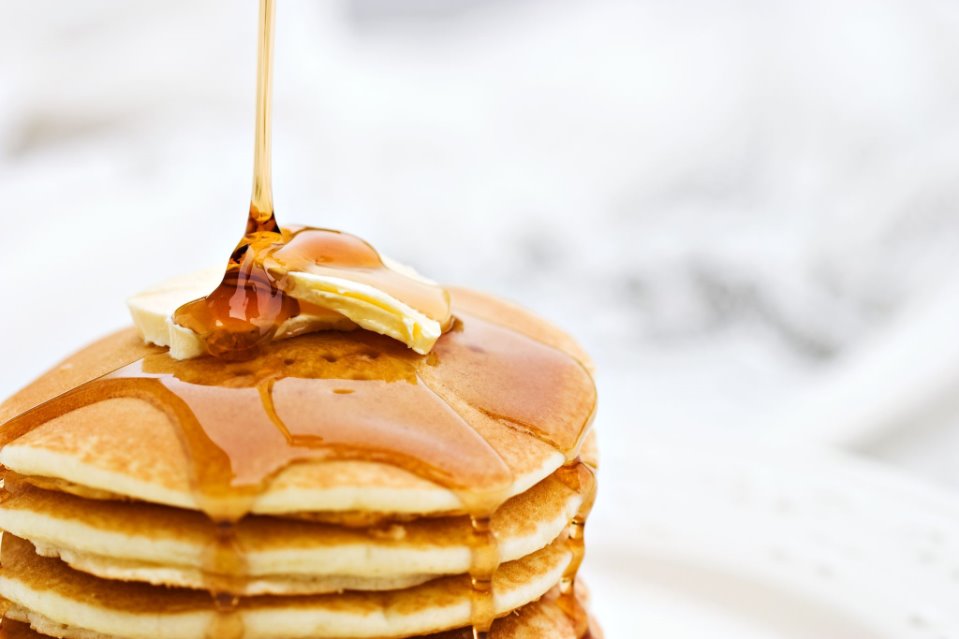
National Pancake Day was yesterday. As usual, I’m a day late and a dollar short. Nevermind that I had a pecan waffle with extra pecans sans syrup at the Waffle House this morning.
Still and all, I offer you this, my homage to maple syrup (and to pancakes though indirectly.)
As a child, I did not like pancake syrup though I loved the shape of the Aunt Jemima glass bottle. Everyone thought I was weird, but I much preferred my pancakes and French toast with tons of butter. Dripping with butter. Drowning in it. Floating.
Some time during my misspent early adulthood, I did not mark the day in my calendar of things to remember, I was unceremoniously given pancakes with syrup already applied. Not wanting to be one of those people, I unenthusiastically loaded a forkful and put it in my mouth.
Oh my. All the pleasure pheromones and chemicals and other assorted signals lit up like a Christmas tree at the North Pole and I smiled big and broad.
Real maple syrup tapped from trees is one of God’s gifts
Actually, I wasn’t all that hidden when sitting there, but most people didn’t look up to peer for children amongst the branches.
I clocked a lot of hours in that tree.
Williams was a dead-end street so there wasn’t much to see other than the occasions when the neighbor’s teenager would climb onto their roof and play his trumpet. Weird kid. Bad trumpet player, but I suppose he should get credit for practicing.
I’m sure that I dragged a book up there with me now and again, but I don’t remember reading in the tree. Of course, I read everywhere. I read like most people breathe – everywhere all the time.
I was older—12, 13, 14 – on the cusp – living my life, but also waiting for it to begin.
I do remember one vivid day at 14 when I waited for my boyfriend while sitting in the tree and there he came, bepopping down the middle of Williams, carrying the largest heart-shaped box of candy I’d ever seen. Whitman’s. It was Valentine’s Day – a special occasion. I usually did my tree-sitting in the summer.
I liked being in the tree. I felt hidden and the configuration of the branches made climbing easy. The trunk and major limb were in such a position as to make reclining in the tree very comfortable for my lithe teenage self.
One summer I took to making caftans out of old sheets. I’d waft around in yards of white percale dragging behind me and eventually climb the tree –no mean feat in an oversized sheet and sit there pondering the universe. Feeling spiritual and Egyptian in my badly sewn caftan.
Kenny-the-roof-trumpeter had nothing on me in the weirdness department.
I do remember dragging bags of Doritos into the tree with me. I carried the bag in my clenched teeth reserving both hands to scramble up the tree. Doritos were the new snack and took the country by storm. There were two flavors – plain and taco. I loved the taco ones and considered the bag a single serving. I was always hungry in those days. A bottomless pit of hunger and volatile hormones.
I’d wipe my orange-stained fingers on my caftan when done.
So, there I was, a long gangly teenager in a bedsheet streaked with orange stains perched in a tree going through puberty one long summer day at a time.
It just wasn’t Saturday without Tom & Jerry, Felix the Cat, and Bullwinkle & Rocky, but my favorite cartoons were the old classics: Silly Symphonies and all the Looney Tunes. Oh, how I laughed. Oh, how I was entranced. Dancing teacups, sentient plants, Singing tubs of cold cream. No wonder we grew up to be the generation that put music videos into the mainstream.
My brother and I would assemble on the floor in the living room. Bowl of cereal in front of us far too close to the television. Mom would say, you’re too close to the television and we would scooch back. After two bowls of Sugar Pops with the Sugar Bear mascot, I’d be wired for sound. I did love that cereal which is odd because I wasn’t much of a cereal eater as I hated milk. I often ate my sugar pops without or as little as possible.
Funny, but I can’t remember the order of the cartoons though I remember that I was done by the time Johnny Quest came on. Sometimes I’d watch it, other times not. My brother was done before then and likely in the backyard with his Tonka trucks.
At about the age of 10 or 11, I added American Bandstand to Saturday cartoons. I think it came on at noon. In later years, soul train followed.
When I got older yet, I discovered that often there were old movies on in the afternoon. I Sugar Popped my way through musicals, film noir, Jerry Lewis, and Tammy movies.
Saturdays were blissful. The only real day I didn’t have much to do. Sure, we were expected to clean our room and do other housecleaning duties, but none of that “no playing until chores were done.” As long as we did get it done, we were pretty free to choose when. No school, no church, hours and hours to just be. Laughing at cartoons, reading Beverly Clearly, eating when hungry, and straightening my bedroom when I was good and ready to.
As an adult, I watched cartoons with my son. I wonder if he realizes how cheated he was. Everything has a moral, a lesson, a sponsor. No silliness just for the sake of being silly. No whimsy. No dancing tubs of cold cream.
I am resolved to buy the old Warner Brothers stuff on DVD so that my grandson will have those hours of childhood. Bugs Bunny, Elmer Fudd, The Roadrunner. What a golden period for cartoons.
Hands on the banisters…tight, gripping…trying to catch my breath…heart racing. Doubled over.
I try to breathe normally.
Breathe.
Just breathe.
My breath comes back before my heart quiets. I finish the climb. Out of breath at the top. Again.
I stumble and stagger to the bed.
Laying my body down, the room spins. Ripples of nausea. My dachshund jumps on the bed and licks my face. She is worried. I am worried, too. She burrows under the blanket and curls up against my back.
I am still heaving. Trying to breathe.
Finally, it all settles down–my breathing, the nausea, the spinning. I curl and pull my knees into full fetal position. The dachshund nestles even closer, her nose cold against my back. I can sleep. And I do. Thirteen hours a day. Sometimes more. Rarely less.
They call it Long Haulers. They call it Long COVID. They call it Post COVID Conditions.
What I call it cannot be repeated in polite company.
I am so very weary of being tired, out of breath, aching, confused and scared.
Three years, six months, and ten days now since that phone call. Too anxious to wait any longer, I called the Health Department as soon as they opened. I have been sick for three days. They had tested me two days earlier.
I gave the woman on the other end of the phone my name. My date of birth. Last four of my social. She seemed surprised. “You’re positive.”
“What do I do now?” I could hear her shrug her shoulders.
“Call your doctor?”
I do. I’ve had the same doctor, Hyla, since 1998. She is very responsive. I can’t get through to her. I am surprised. I am desperate. I have the CORONA-19 Virus. I am trying not to panic.
In late 2020, the news outlets report health care professionals are overwhelmed. I am overwhelmed too and newly diagnosed.
I sleep. I call my doctor’s office. I sleep some more. I have a gruesome headache. The headache has been with me for so long, I name it Frank. It is already powerful – naming won’t hurt. I call some more.
I make a tele-health appointment to try and get Hyla’s attention. Finally, she calls. I ask her how long? I asked her if I will be okay? I askk her a lot of questions. She says, “We don’t know.” She says, “The recommended protocol is Vitamin C, Vitamin D, B12, zinc, magnesium, potassium. Arthritis Strength Tylenol. ICU patients show improvement with Pepcid, of all things.” She said, “Elderberry is showing some promise.”
She tells me what to look for and how I will know if I need to go to the Emergency Room.
“Don’t go if you don’t have to. Please.”
Three years, six months, and ten days now since the diagnosis. Before the vaccine. Before the antivirals. “My doctor said, “We don’t know.” Vitamin D. Vitamin C. The Bs. I take them all.
Three weeks after the diagnosis, I am somewhat better. I work from home, but I nap two or three times a day and sleep all night. I don’t know what is wrong with me. I think depression. But the headache?
I take the vitamins. The elderberry. The Pepcid. I sleep. I still have Frank-the-Headache for weeks and then months.
My doctor says, “We don’t know.”
After 9 months, finally, I am better. I shout ‘Hallelujah!’ on my social media.
This is premature.
A relapse.
“We don’t know,” Hyla says when I ask why it came back and how long it will last.
I am called back to the office in the town where I am employed after working at home for months. I discover I cannot walk. I cannot get from my car to my office. The drive has worn me out. Fixing breakfast, dressing for work and thirty minutes on the road might as well have been six months on the wagon trail. Casting off furniture like ballast. My old life gone like pianos sinking in the mud en route to Oregon.
I begin working at home again.
I am exhausted easily and often. I have a built-in seat in my shower. I could not bathe otherwise. I cannot stand but a few minutes or walk a few steps. My thoughts are cloudy.
I insist my doctor see me in person. Long COVID, I suggest. I have been reading the research buzz. I read abstracts online, mostly from the UK as they are releasing studies before the US.
“We don’t know,” Hyla says.
She says, “Good luck.”
I am not depressed, but I am. I develop anxiety.
Hyla says, “That, too.”
Many of us long-haulers do.
I break out in rashes.
“Yes, people report that.”
My old life is gone.
I enroll in a study out of Johns Hopkins. The questions go on and on and list all the possible permutations of Long COVID. I have kept my taste and smell but have no executive function. No cough to speak of, but the headache…Lord, the headache. Mercy, please. And then, body aches. Stiff joints. Hyla says I seem to be mimicking chronic fatigue syndrome.
“Good luck.”
I go back to work at the office. I feed the meter all day long via a phone app so I can park by the front door.
Three years, six months, and ten days now and they still don’t know much. I quit taking the zinc because I’m told to, but I can’t remember why. My short-term memory is gone. Some days my cognitive function is like swimming in a vat of molasses.
I am determined to reclaim my life. I join a yoga class. I can’t do it. Not even savasana–the one where you sprawl on the floor like a dead corpse.
I drop out.
I have failed beginning yoga. I used to take advanced classes.
Periodically, the symptoms abate. The headache is gone. I announce my recovery. I rejoice. Truly. Rejoice. I have hope again.
I feel almost good when I wake, though I tire easily. I tell myself I am just out of shape. Six to eight weeks of relative calm.
And then I relapse.
Another recovery. Another Hallelujah! Another relapse.
“We still don’t know.”
I am at the beach. My friends drive me to doors. Carry my things. It takes me half an hour to traverse the block to the chair they have set up for me as close to the boardwalk as possible. I discover I cannot stand in the wet sand. Can’t keep my balance when it shifts with the surf. I want to cry, but I laugh instead.
Long COVID is not going to beat me.
Three years, six months, and ten days. The WHO reports that 6,938,353 people have died from the coronavirus COVID-19 outbreak as of May 31, 2023.
For the 760 million people with COVID who didn’t die, 20% or more had or have Long COVID. Some for weeks, some for months.
Me? Three years, six months, and ten days.
My case is considered mild. I am one of the lucky ones. I did not die. I have not been declared disabled. I have not had to quit my job. I do not have to use a wheelchair or an oxygen tank. I have been fortunate. The initial illness itself, too, was mild. No hospital.
The doctor is as weary of saying “we don’t know” as I am of hearing it.
Elderberry. Vitamin C. Vitamin D. B12.
Lucky.
They begin to know some things. I am given Lorazepam for the anxiety and Modafinil for executive function. I have a rescue inhaler. They help but are not enough. I am not well, though I no longer have the headache. I begin to consider my future.
What if this is as good as it gets? This. Right now. Living this way.
It’s time to go to bed. I must climb the stairs to get there. It will take all the strength I have left. I will lie there for a few minutes, gasping, scared before I can breathe. Scared after. Still and all, I will settle into sleep to do it all again tomorrow.
The dachshund burrows next to me.
Three years, six months, and eleven days.
A long long-haul.
NOTE: This was written some time ago. The doctors have me on a drug cocktail that works for me. I feel infinitely better.