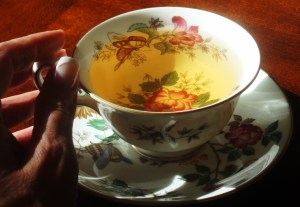
A cup o’bloomin’ tea.

Tea can provoke a need for candlelight.

Tea can provoke a need for candlelight.

My family are not tea drinkers. We had iced tea (no sugar – sweet tea was for communists), but we weren’t hot tea drinkers. Oh sure, the parents would let me order tea when I was 8, but they thought I just wanted it for the little silver pot. I did, but I also enjoyed the tea.

I got introduced to “Russian Tea” when I was 14. It was a dark black tea with cloves, dried oranges, cinnamon, star anise and something else. It was the first tea I ever had that was supposed to be lumpy and leave dregs. I’ve searched multiple states and multiple countries for it with no luck. Just last Christmas I found a reasonable substitute at a bookstore – Harney & Sons Hot Cinnamon Spice (with orange and cloves). It’s a lovely tea and I’ve grown fond of it.

The well-used kettle.

The well-used kettle.

I’m an unrepentant coffee drinker. Folks are astonished at the amount of coffee I drink. I’ve been told I’d fit right in at an AA meeting. I drink a pot of coffee before I even leave the house in the morning and another throughout the day. During the day, I’ll often also brew green tea. Or chamomile. Sometimes an Oolong.

I enjoy the ritual of tea – the boiling, the steeping, the pouring, and the accoutrements.

Oolong.

Oolong.

I like trying to “read the leaves.” I stir and watch the steam swirl. I deeply inhale the fragrance. Coffee is gulped, tea is savored.

I drink my coffee black except for the very rare occasion I have dessert – in which case heavy cream is required. But tea – now tea positively requires additives mostly because of tea sets – you have to put something in all those containers and if you’re going to put something in there then you have to use it.
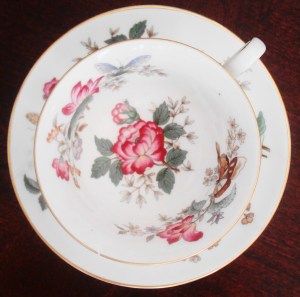
The very-special English teacup.

The very-special English teacup.

I love tea sets and tea pots and tea cups. Coffee is everyday – utilitarian. Well, mostly it is. Sometimes coffee is just a caffeine delivery system and sometimes it is a spiritual experience. Tea, however, always provokes ritual. Sugar cubes, creamer, lemon, honey, Demerara sugar, spoons, tongs, pots, trays, kettles, shortbread cookies, and comfortable rockers.

Tea is not a beverage, it’s a mind/body experience.

The even more special dragon cup (and tea service).

The even more special dragon cup (and tea service).

I like a little Mozart with my tea.

My teapot collection, while not large, is diverse. Some of it is very formal even if I do almost always drink tea in faded jeans. The tea cup collection is far more sparse. I vow, now and again, to get more, but I’m usually overwhelmed by the choices.
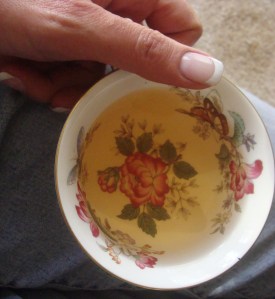
Tea is almost always enjoyed in well-faded jeans.

Tea is almost always enjoyed in well-faded jeans.

Lipton’s black tea is fine. Cheap herbals are fine. Luscious imported teas, delicate whites, organic herbals and the like are, of course, much more appreciated. I love to hold the cup close to my face and breathe in the steam and aroma.

A couple of years ago I discovered in a magazine the “blooming teas.” These immediately rushed to the top of my “must have” list. Showing restraint, I did not order them and when Chef Boy ‘R Mine asked what I wanted for Christmas, I told him. My restraint centered on the fact that without the special teapot, the wonder of blooming tea is not fully realized.
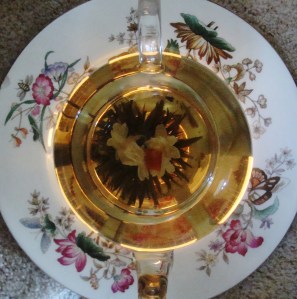
Blooming tea.

Blooming tea.

Blooming teas are hand-tied bulbs of tea and other botanicals including dried flowers. When the boiling water is added, the bulbs “bloom” and one ends up with a floral arrangement in their teapot. It doesn’t get much cooler than this.

Said tea requires a glass teapot and a tea candle so that the blooming tea is visible. Brewing this tea is most spectacular in a dark room. The blooming teas are almost always one of the white teas; hence the tea is an amber color. With the tea candle shining upwards through the bottom of the pot, the view of the blooms is wondrous – a Monet water lily with a golden cast. The ritual of tea takes on a whole new facet with these bulbs.
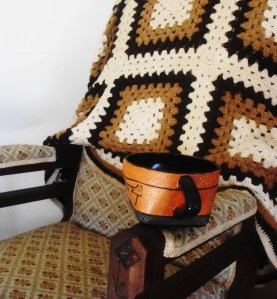
Tea often demands a good book and a comfortable rocking chair.

Tea often demands a good book, an afghan and a comfortable Victorian rocking chair.

Still, I like the old standbys. Oolong is a favorite because it has the same mouth feel as coffee. The cinnamon/clove/orange tea is great heavily sweetened and drunk on a cold winter night. Chamomile is spectacular with honey and lemon.

When in England in 1998, I learned to drink tea with cream. I was in a little tea shop complete with white table cloths and a platter of “biscuits.” The tea was served with cream and sugar. When in Rome and all that. It was quite lovely and there are some days I just I have to have tea prepared that way along with some Walker shortbread cookies.
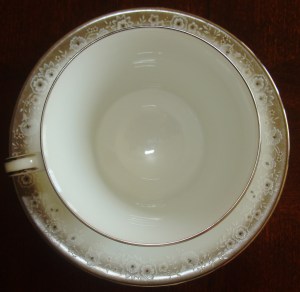
My 13th birthday china.

My 13th birthday china.

It’s always been interesting to me how and why we acquire the habits we have. I’m not sure why I’m so entranced with tea, but I suspect it’s the cups and teapots. I have more dishes than any one person can justify, because I love dishes. Now there’s a habit I can’t begin to explain – fine china, hand-turned pottery, hollow-stem champagne flutes, sushi plates, whimsical turkey soup bowls – you name it, I have it.

Tea is ritual – it’s the very epitome of right here right now.  It slows me down, centers and grounds me.  It’s a lovely respite from real life.

[If you’re into tea and ever in the D.C. area, don’t miss Ching Ching Cha’s – it’s a Chinese tea house that will, I promise, rock your world.]
The Art of Doing Nothing

Nope.  Not gonna do it.

Nope. Not gonna do it.

Just as our bodies need downtime in the form of sleep, our bodies need downtime during our waking hours.

I’ve had a drought of downtime both asleep and awake.

Today, when the alarm went off, I silenced it, rolled over and went back to sleep. I clocked something like 10 hours. It wasn’t enough to eradicate my sleep deficit, but it was enough to provoke a feeling of well-being.

Yesterday, I did just enough housecleaning that I didn’t curl into fetal position when I went downstairs this morning. [It’s still a mystery to me how the house can become a Super Fund site when I’m never here.]

I plopped my ass on the sofa. After a few minutes, I arranged myself in a supine position. A few minutes later, I pulled the blanket over me. The dogs and I reacquainted ourselves there on the sofa.

I announced, firmly, “I have things to do.”

I got up, poured another cup of coffee, and stared out the window at the kitchen garden – looking at the mess I never had time to get to.

I forced myself to take clothes out the dryer, put the clothes in the washer into the dryer, and put the last load of laundry into the washer.  Drudgery, pure drudgery.  The inner adult had wrestled the inner child into submission, but neither were happy.

I poured another cup of coffee and stared out the window some more.

I announced, firmly, “I have got to motivate.”

Deciding that perhaps some sunlight on my pineal gland would help, I toddled out to the garden and plopped my ass in a lawn chair. From that seated position, I willed the calla lilies to bloom. I noticed that the morning glory had wrapped itself around the gate making ingress and egress impossible.

I contemplated getting up and whipping the morning glory into submission.

Stating clearly and audibly, I said, “Fuck It.”

Without getting too technical, the FuckIts are that state wherein no matter how hard your inner grownup spanks the inner child, nothing on the to-do list is going to get done without a change of strategy.

Nothing.

Facing this knowledge, the person with the FuckIts will develop a great sense of peace and sometimes giddiness. I am not going to do a damn thing and you can’t make me. It’s not rebellion, obstinacy, defeat or disobedience.

It’s very nice. It’s a lot like when you have a killer headache and you notice, suddenly and with pleasure, it’s gone.  The to-do list evaporates.

In my Geek Girl persona, I equate it with rebooting the computer. When you’re holding too many tasks in memory, sometimes you just have to reboot. (You Mac people can just shut up now.)

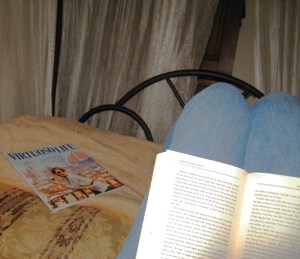
I trundled back into the house and heated up leftover tuna casserole. I settled in with a book – a bite of casserole, turn the page. Bite, turn.

Self permission to do nothing is energizing.

mmmmmm book and a nap

mmmmmm book and a nap

I’ve wandered about the house with the book. With no hurry, no agenda, no sense of looming responsibilities fixin’ to fall on my head and destroy me, I’ve managed to do even more cleaning between chapters. Paid some bills. Found and removed the source of the gnat problem in the kitchen. Readied my clothes for the following week. Put the jewelry back into some order. Cleaned off the desk.

I’ve actually done more than was on the to-do list to begin with.

People who are into meditation talk about this phenomena all the time. Quieting the chatter of your mind, either through counting breaths, repeating a mantra, or giving yourself permission to do nothing allows you to accomplish so much more. The essence is simply doing, or not doing, without thought of the past or the future. Without haste.

I had a fledgling meditation/yoga practice going that I abandoned when the to-do list got daunting. Big mistake. I haven’t been on the exercise bike (white noise and muscle toning all at the same time) in weeks. Another big mistake. I haven’t been reading well-crafted novels or listening to the music that makes my heart soar.

No wonder I’m a cranky bitch.

Doing nothing is both a luxury and a necessity.

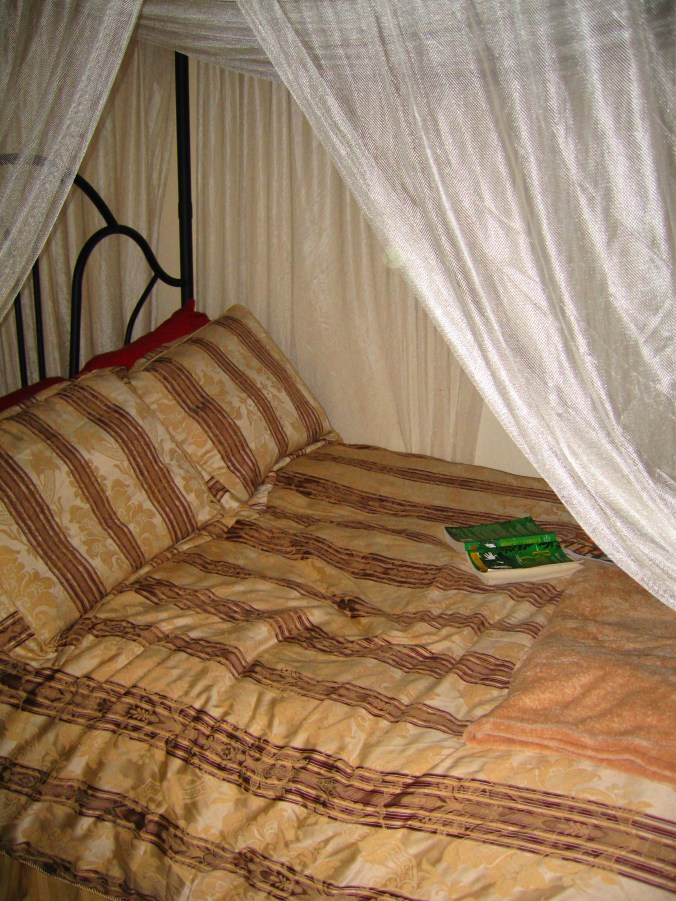
I’m going back to my book now. I’m kinda thinking that napping in the guest bed in the afternoon sunlight after reading some of the book would be nice. If I do that, I’ll probably put clean sheets on the bed and vacuum – after watching the dust dance in the air for awhile.

Routine (or the New Normal)

I’m working part-time at a group home for teenagers. The kids are there because of stuff they did or because of stuff done to them. In most cases, though certainly not all, these kids have lived a life of routine that does not have a discernable pattern – or in other words – no routine.

For years, I viewed the concept of routine as a Great Evil to avoid at all cost. I was, and perhaps still am, convinced that routine stunts creativity and turns us into automatons. But more on that later.

Anyone who has been charged with the responsibility of taking care of a three-year-old understands the importance of routine in a child’s life. Toddlers without a routine are some of the most miserable beings on the planet. More importantly, they know this. If you change a toddler’s routine for any reason, in most cases (aside from holidays, vacations, etc.), the toddler will scream blue-bloody murder.

When Chef Boy R’ Mine was that age, any deviation from the weekly routine turned him into a hyperactive monster prone to tears, rage, and publicly embarrassing behavior. Being sufficiently enlightened, knowledgeable about child development, and having examined all of my parents’ shortcomings as parents, I, like nearly every other parent, was convinced that my child would always be happy and well-adjusted. It’s such a rude awakening when enlightenment, knowledge and introspection does not, in fact, make a damn bit of difference as to whether or not the child is going to have a tantrum at the Kroger.

Anyway.

The older the boy got and the older I got, the more I realized that routine is not just important to toddlers, it’s important to everyone. It’s not the blanket evil I was once believed to be true.

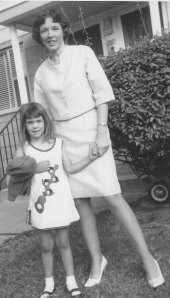
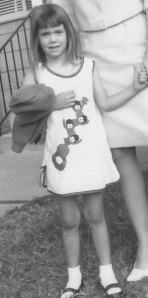
My first day of school.

My first day of school.

The beginning of the school year was always a time of relief and rejoicing. Staples used to run a commercial with a happy, frolicking father tossing school supplies into the basket with great glee. His two disgruntled children watch. I laughed every time I saw it and said Amen! I thoughtfully provided the commercial at the beginning of this post.

The start of school signaled a return to routine. After a couple of months of flexible bedtimes, erratic meals, impromptu outings, and any number of unscheduled activities, we were all worn out from too much deviation.

Now of course, school brought its own challenges, but there was a carved in stone routine that was only interrupted by Labor Day, Halloween, Thanksgiving, Valentine’s Day, Easter and Memorial Day. Those interludes provided needed respite from the grind, but like the first day of school in August, I always looked forward to January 2nd when the holidays were officially over and we could get back to the routine.

At the group home, the first thing we do is put these kids on a schedule. They have standard mealtimes, standard bedtimes, and a daily rhythm that doesn’t vary too wildly. They chafe at first, but like the toddlers they come to both expect it and need it. The minute something gets off-kilter, they get hyperactive and there are tears, rage, and the occasional tantrum. Routine is good.

As the years went by and I began noticing how much I looked forward to the first day of school (and January 2nd), I realized that routine was important in my life too. While it does inhibit my creativity and does, to some extent, turn me into an automaton, the emotional equilibrium that routine provides does mitigate the downside. For the most part.

Several years ago, I became disgusted with my routine and made some sweeping life changes. I do not regret this.

Can you see John Lennon's head?

Can you see John's head?

However, these sweeping changes punctuated by some disasters of varying importance have left me, metaphorically, in the cereal aisle at Kroger having a tantrum. Everything is in flux and while I can envision the goal line, I cannot see it. (I can’t believe I’m using a sports metaphor, but there you have it.) I had a plan and I have goals, but I don’t see the plan being executed for another 5 to 7 years which means attainment of the goals are going to take even longer. I have resisted looking that truth in the eye.

I am emotionally exhausted and prone to rage and tantrums. I am simply tired of not knowing what I can expect from the next day, the next month or the next year. I’m fond, perhaps too fond, of quoting John Lennon’s “Life is what happens when you’re busy making plans.” It’s good to have goals, but that doesn’t preclude having a routine or abandoning a plan that can’t be executed under the circumstances. Muttering “This too shall pass” has been comforting. It may very well be passing, but the movement is so slow as to be imperceptible.

I have chafed at the routine that is trying to emerge, because it is in direct opposition to my goals and expectations. I had a major setback yesterday. I’m still reeling. I do know that the chafing, the grumpiness, the rage and the tantrums have not changed one damn thing. I need to embrace the latent routine and accept my New Normal.

So. My task for the day is to try and fine tune the routine that I think circumstances are dictating; and tweak it enough to insure I don’t become a bitter, old woman whose creativity is limited to seeing what happens when she substitutes Campbell’s Cream of Celery soup for the Cream of Mushroom in the tuna casserole.

The New Normal I’m trying to talk myself into embracing is so far outside my realm of experience (and not in a good way) that figuring out how to turn it into something that’s going to work for me is daunting. I do know that viewing it as temporary is not working. For years now, I’ve hung onto arbitrary timeframes uttered by doctors, lawyers and Indian chiefs that have proved to be complete fiction. There is no goal line in sight. (Damn it, did it again.)

So, channeling the sentiments of many sages, the goal is to be right here, right now with a routine, day in and day out, that doesn’t ignore the future, but doesn’t treat the now as the aberration. The now is the future. I will resist discussing quantum physics to make this point.

And this all seems much grimmer and whiny than is my intention. I’m more at peace right now than I have been. Years ago when the New Normal began, I would have told you I couldn’t have gotten to this day without losing my mind. While my mental health has ups and downs, I have not worn a strait jacket or been prescribed haloperidol. While I’m not dancing around singing “It’s the most wonderful time of the year,” I am also not railing at the universe.

Now then. If you’ll excuse me, I have a set of chores that I’ve previously allotted 9 hours to, but which the New Normal dictates must be done in 45 minutes. I need to get cracking.

(Nonexistent) Spare Time

Photo by TheMarque - used under a creative commons license

Photo by TheMarque at Flickr - used under a creative commons license

In my nonexistent spare time, I’m doing some work at an emergency shelter for teenagers.

I must be getting old.

For fourteen years, I worked on a college campus. In addition, I was a teenager (once upon a time) and I raised a teenager. I hadn’t expected to be surprised by these kids.

About every two hours or so, one of them surprises me. Far too frequently, one of them will surprise me to the point of speechlessness. I’m rarely at a loss for words.

In 13 days, I will celebrate the golden jubilee of my existence. I’m rather excited about turning 50 though I can’t quite articulate why. I am discovering the Big 5-0 is a time for reflection. While I don’t feel it’s possible that I’m 10+ years past the age I was convinced my parents were elderly and on the verge of nursing home care, I do know that I’ve got enough years behind me that every now and again true wisdom pops up in my brain – the brain that still feels 25 in the body that’s feeling every year of 50.

Working with teenagers at this junction encourages that reflection and results in some brief glimpses of insight.

I was the teenager from hell. Fortunately or unfortunately, depending on your point of view, I was intelligent and strangely responsible with my delinquent behavior. I had goals and I managed to get through a surprisingly good public school system with a solid 3.92 average. I worked 20-30 hours a week. In my (then) nonexistent spare time, I also partied like it was 1999.

The saving grace was that I loved and respected (kind of) my parents.  I loved them and they loved me.

I told my son there were few things he could do that I hadn’t done; and, unlike my parents, I knew what to look for. While there were days I said to him, in stunned disbelief, “Who raised you?” we managed to get him through those years with minimal trauma.

At this point, I’m probably sounding like a hypocrite.

Those all too brief episodes of wisdom are bearing fruit.

They tried to tell me then and I try to tell them now that they have years and years in front of them, but youth is all too fleeting.

I would love to have the attitude and joy of being a small child again – the wonder at the world and the excitement of discovering it. I wouldn’t be a teenager again for nothing. Folks say they’d love to do it again knowing what they know now. Not me. They’d have to drag me kicking and screaming back to the time of Clearasil.

These kids I spend time with 25 hours a week are a mess. Most of them haven’t willfully done anything I didn’t do. The difference seems to be what has been done to them.  By their own actions and by what’s been done to them, they’re growing up far too fast. 

Some of them are there because of things they’ve done that landed them in the criminal justice system. Others are there because of things that were done to them that landed their guardians in the criminal justice system. Others are mentally ill. Some are there because their parents couldn’t control them and voluntarily turned them over to state custody.

College professors are consistently amazed at the irresponsible and dishonest behavior of their students. They’re further disgusted at the lack of basic skills these kids are coming out of high school with. Some of them put the blame squarely on the kids. Some on the public school system. Some on the parents. Some on all three. Rather than blaming, I’m more interested in figuring out what we’re doing differently with our kids that leads to this behavior and attitude. If we can figure that out, we can stop it before it starts.

In my other job, I work with folks committed to prevention of child maltreatment. The statistics and the research strongly show that it’s far more effective and less expensive to prevent the problems in the first place than to react to them later.

This job offers the flip side. What I see is that we’re dumping tons of money on this problem. Money that needs to be spent. But I wonder about the efficacy of it. It’s a temporary shelter so I don’t get to see what happens in the long term.

What strikes me about these kids in the shelter is how young they are and how old they think they are. The problem lies in that junction. They chafe, in ways I didn’t, at our attempts to control and change their behavior. So many of them have an attitude that this is all there is. Those that do have goals have ones that are shallow and center on the acquisition of stuff or the attainment of fame. They don’t want (or don’t they can) contribute something of real worth. Or they have no concept of what is worthy.

At their age, I felt like an adult. As an adult (and I use that term loosely), I know now that I didn’t feel like an adult – I felt like a teenager with the accompanying raging hormones and brain that had not yet lateralized. Hell, most of the time I still don’t feel like an adult.

It’s too easy to throw up our arms in despair and declare the problem too big to deal with. There’s an old story that makes the rounds of intervention folks – The Starfish Story. It was written by Loren Eisley. In short, a man on a beach sees miles of beached starfish and encounters another person picking them up and throwing them back into the ocean. The man points out to the other that he can’t possibly make a difference as there are hundreds of starfish and miles of beach. The starfish thrower says, as he tosses one back into the ocean, “”It made a difference for that one.”

My work at this group home is not onerous. Mostly, I sit and talk with the kids. Every now and again, I get the opportunity to say something that I hope is the equivalent of tossing a starfish back into the ocean.

What I need to learn, and this is probably true of life, is that while I will not get to see if my actions provoke positive results, the simple act of doing is still worthwhile.

I’ve spent this morning bemoaning my loss of free time. This job began as a means to alleviate some financial distress. It’s becoming something more. I’m learning something from these kids and I’m learning something about me. Time will, perhaps, illuminate more clearly what it is I’m learning. It’s possible that the starfish I’m saving is myself.